
Switzerland-based NexaVM has an all-in-one VMware replacement suited for mid-market and regional CSPs, sovereign cloud, and local integrators.
It says it’s a a European-led virtualization and private-cloud platform positioned as a modern alternative to VMware environments, with a production-grade hypervisor, integrated software-defined storage, Kubernetes services, and multi-tenant cloud management in a single stack, with a strong focus on MSPs and service providers building sovereign or regional cloud offerings. It provides vSAN-style hyper-converged Infrastructure (HCI) storage, providing block (Ceph), file, and object (S3) services, with erasure coding and multi-interface I/O paths, as well as having support for external storage connected by NFS, iSCSI, Fibre Channel, and NVMe.

The nexaVM SW stack includes native multi-tenancy, quotas, metering, and REST APIs, and service catalog use cases. There is a cloud control plane with integrated Kubernetes-as-a-Service and Private AI-as-a-Service, and a VMware migration facility. We wondered how NexaVM differentiates itself from other VMware migration targets such as Nutanix and VergeIO.
Sales Manager Manuel Minzoni told us: “Nutanix and others are highly capable platforms, particularly in global enterprise HCI estates. Our experience is simply that nexaVM is frequently selected where customers prioritize usability and TCO, automation, sovereignty, and predictable economics over large-scale appliance-centric deployments.”
In his view, there are three board VMware replacement customer types;
- Mid-market and regional CSPs looking for;
- Predictable subscription licensing,
- No HW lock-in,
- Multi-tenant isolation with quota-based self-service,
- API-driven for VM, Kubernetes, and object storage services.
Secondly, customers in sovereign cloud and regulated environments want;
- On-prem or sovereign deployments,
- Full lifecycle control of compute, storage, and Kubernetes from one control plane, with lighter operational overhead than large multi-product stacks.
Thirdly, HW-agnostic OEMS and local integrators who need;
- Certified operation across multiple server vendors,
- Flexible BOM design,
- Tight integration with enterprise SAN or NVMe-based SDS, without being bound to a vertically integrated appliance strategy.
The curious and somewhat mysterious NexaVM Technologies AG company was founded around 2005 in Lugano and its history, funding and leadership team details are akin to a private Swiss bank, meaning opaque and hidden. The only exec we know of is CTO Jack Chan who joined in October last year according to Linked -In. Minzoni tells us: “The CEO of nexaVM is Jack Chan – we were former colleagues at Sangfor.” Four or five other sales people and engineers are mentioned on LinkedIn.
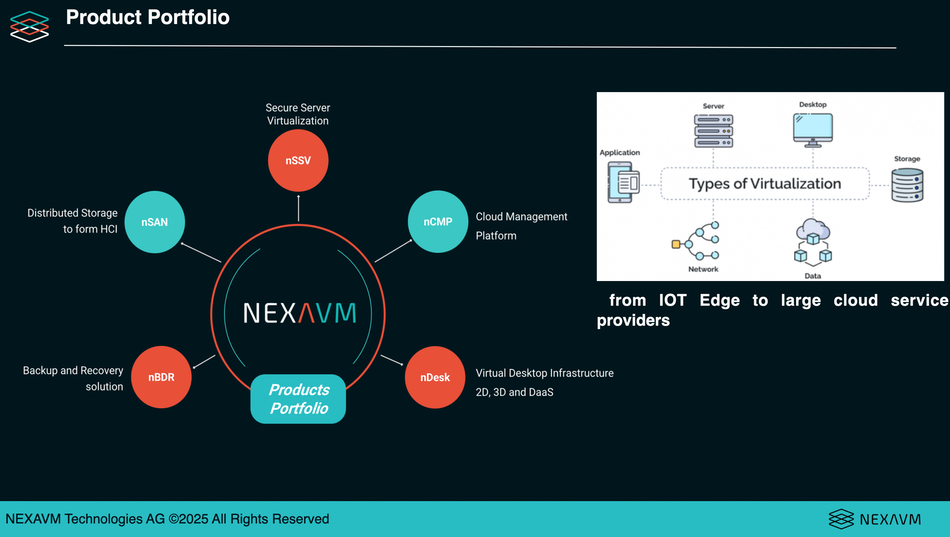
It started its nexaVM product development in 2015 with nSSV (Secure Server Virtualization – based on KVM), and its SW suite includes nSAN, nCMP (Cloud Management Platform), nDesk (VDI) and nBDR (Backup and Disaster Recovery). Alibaba invested in 2017, and it reached the 200 customer point, with 1,000+ claimed in 2019. We think Alibaba provided a gateway into the Chinese market. Arm support came in 2020 and it claimed 80,000 sockets (it uses per-CPU licensing) shipped that year. There were 600+ partners in 2022, and 3,000+ enterprise customers in 2023, by which time it had shipped 150,000 sockets.
In 2025 it went past 4,500 customers in 25 countries world-wide, and 300,000 sockets shipped. Alibaba put in more money. This is, to say the least, respectable growth by anybody’s standards. NexaVM has made its SW available to OEMs and the company started expanding, building on its existing global presence, supported by ZStack (Chinese cloud infrastructure SW provider) and Alibaba, which now has a controlling stake in ZStack.
Interestingly a NexaVM self-service portal uses the ZStack CMP (Cloud Management Platform);
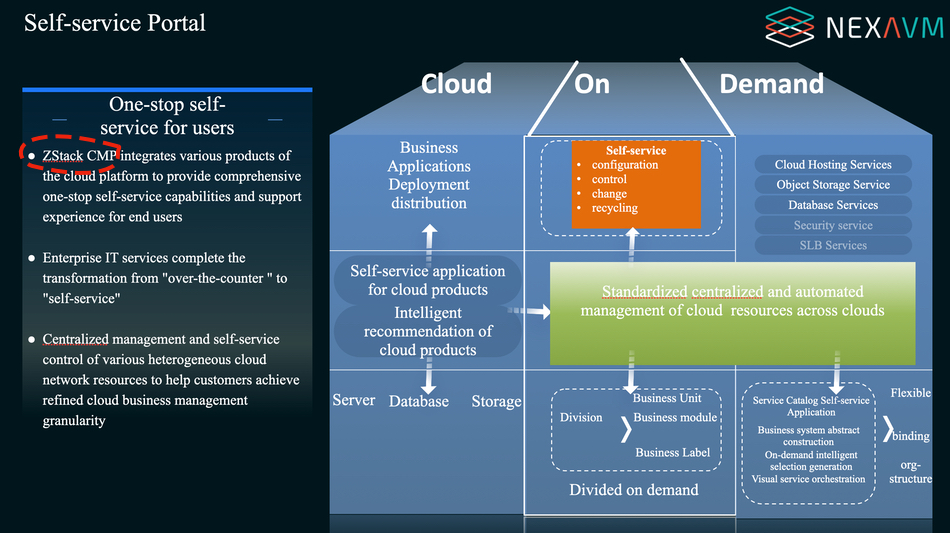
We think there could be some level of integration between the ZStack and NexaVM software components.
All-in-all, our understanding is that NexaVM is actually an already-successful VMWare replacement business that now wants to expand beyond its more than 4,500 customers. It’s expanding partnerships across hardware vendors, storage platforms, and backup/DR providers, alongside certification programs for integrators and MSPs. Roadmap priorities include deeper backup integrations, extended Kubernetes services, additional enterprise-storage connectors, and automation features for large-scale service-provider environments.
We would think Nutanix, VergeIO and other VMware replacement businesses are facing a relatively new competitor with a good track record.
Download a NexaVM company profile slide deck here.