
How would StreamFast eSSD drives fit into the Open Flash Platform with the absence of storage servers?
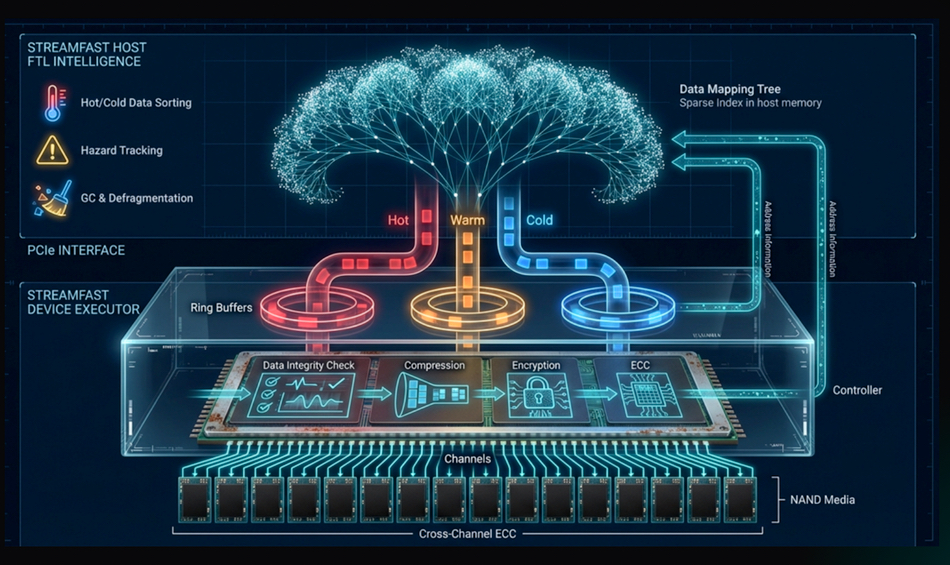
StreamFast is focussed on developing new style SSDs which have external data server functionality running inside then and which store arbitrary-length data strings in sequential order. The Open Flash Platform (OFP) wants to remove external data servers from the data pathway between file-accessing client systems and storage drives.
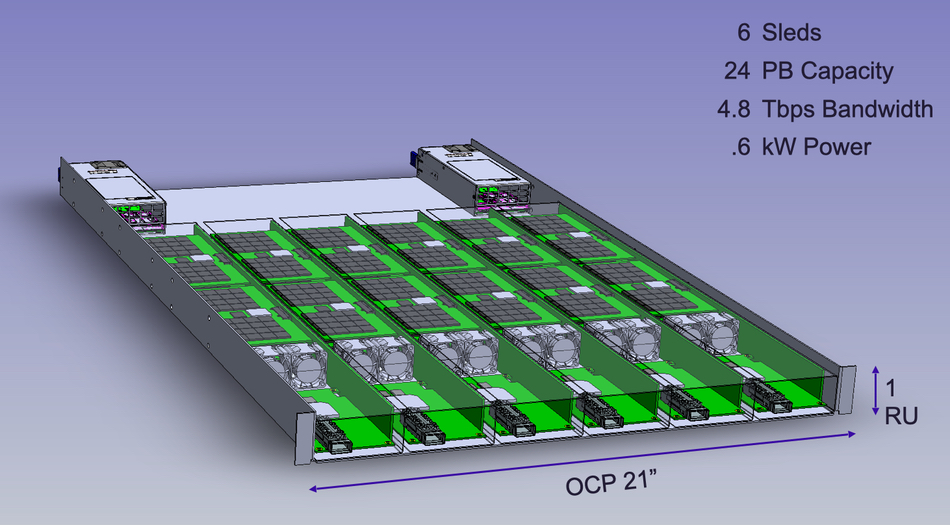
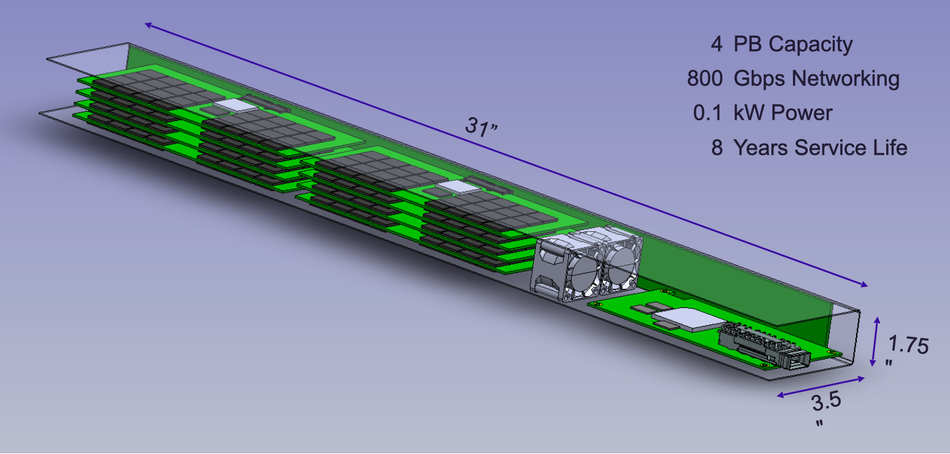
This is the third of a trio of articles looking at StreamFast and the OFP,which aims to produce a 1 exabyte rack of flash storage capacity. This 1 EB OPF storage rack uses 1 RU trays with up to six thick E2e ruler format sleds slotted into them, each with 4 PB of capacity and 800 Gbps networking. An OPF diagram shows what appears to be 12 individual NFS eSSDs in the sled, in four sets of 4-high drive stacks, suggesting each U.2 drive holds 333.3 TB; let’s say 330 TB. But this is a prototype with representative diagrams, so we shouldn’t get hung up on absolute numbers.There’s also an Excite DPU in the sled.
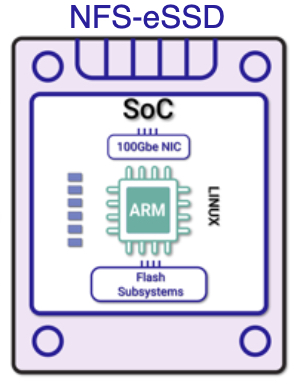
The eSSD is essentially a System-on-chip (SoC) with a Linux storage server, NFS and pNFS in its kernel, running on an Arm CPU, plus a 100 Gbe NIC and QLC flash subsystem.
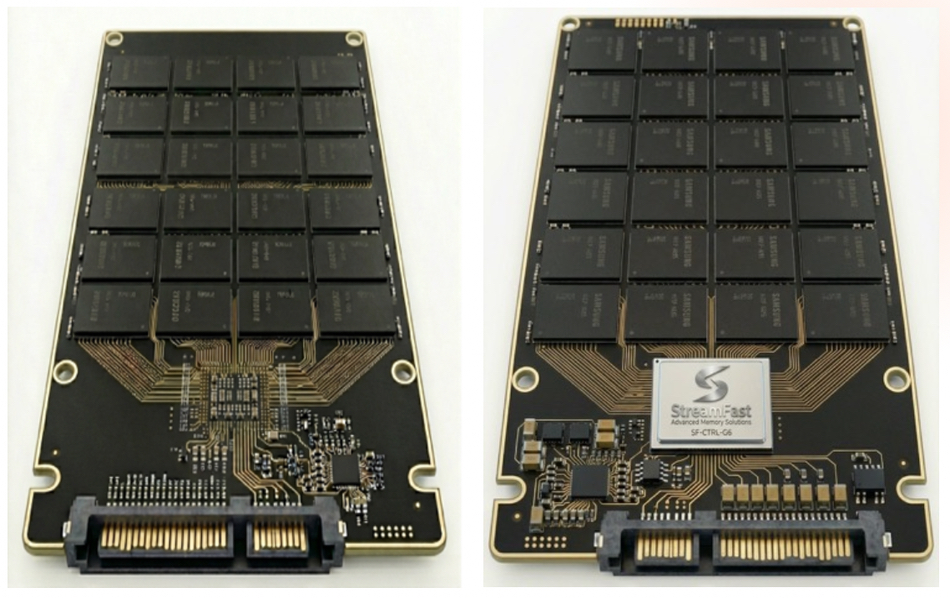
Images of the drive show a U.2-like format, and Samsung NAND dies; 24 to a side, with a StreamFast-branded chip, presumably the Arm CPU;
The OFP rack design envisages a top-of-rack network switch plus a top-of-rack 24 PB flash tray with the rest of the rack used for GPU servers. People could have storage-less GPU servers with them booting off a drive in the OFP tray using a PCIe Gen 5 bus. Flynn tells us “You could use RDMA because that’s in the rack.”
He said: “GPUs can use direct physical stream addresses to those blobs of data on the SSD controller. … The StreamFast architecture with physical demand addressing will be the way GPUs will access things.”
Hammerspace is funding the prototype work and taking in input from potential customers. CMO Molly Presley tells us: ”Obviously there’s a lot of input from our customer Meta about it, who is part of OCP. And so we’re trying to get both hyperscaler as well as industry supplier input and support for it. We do have fp trays built now. It is not a concept. They’re built. They’re running, they’re in labs now and we’re getting our next step to build at scale in place.”
The timescale is short: “It’s moved incredibly fast as far as going from design into now getting ready to build at scale. And that’s driven largely by the orders that we have, for which we plan to deliver kind of in the summer timeframe.”
An Excite January 2026 TechFieldDay presentation provides a sense of what’s going on.
Overall, if OFP numbers are accurate; more than 10X increase in density, 90 percent electricity draw decrease, 60 percent longer operational life, and a 50 percent lower TCO than equivalent NAS arrays, then nothing else comes close to OFP storage in terms of density, rackspace take-up and power efficiency. In this AI-driven period of increasingly exensive NAND (and even more expensive GPU high-bandwidth memory) it surely pays to make the best use of flash storage, particularly if, like hyperscalers, you are deploying at scale.