
BANDF AD
Pure Storage is making a large number of announcements at its Pure Accelerate 2025 event, subsumed under an Enterprise Data Cloud heading.

It divides them into three groups: intelligent control plane, to deal with operational complexity and primarily Fusion-related, a unified data plane to handle siloed and fragmented data on-prem and in public clouds, and cyber resilience with SLA services to cover malware threats and regulation. A Pure graphic relates this tripartite concept to its product capabilities.
BANDF AD
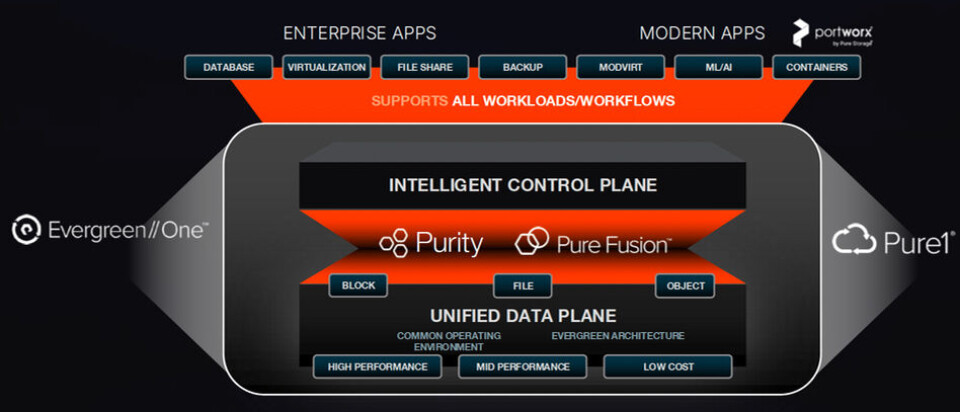
The Enterprise Data Cloud, built on Pure Fusion, which unifies Pure’s on-prem and public cloud storage, was announced in June, giving customers “the ability to easily manage their data across their estate with unrivaled agility, efficiency and simplicity.” We are told block, file, and object data is managed and governed by policy, every system and site contributes capacity and performance through a shared virtual layer, and all data is controlled through a single console.
The hardware news is included in the unified data plane section and we’ll look at that section here, starting with the hardware since that underpins its on-premises presence. The intelligent control plane and cyber-resilience news will be covered in a second article.
Hardware
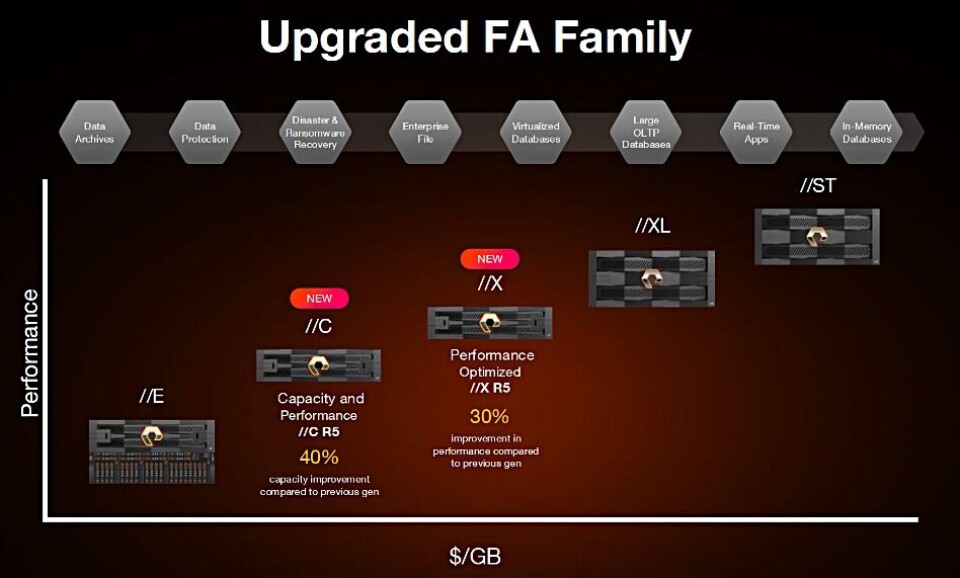
There are five FlashArray product lines, positioned in a 2D performance vs capacity space by a Pure diagram:
BANDF AD

The June event saw the FlashArray//XL line upgraded to a fifth generation, R5. Pure has announced a new top-end //XL model, the FlashArray//XL 190 R5, an evolution of the XL 170. Pure International CTO Alex McMullan told us: “It’s essentially a higher performance version with a lot more memory on board and we’re also piloting effectively a DRAM RAM drive capability within this system as well.”

He added: “I’m not going to disclose how much DRAM is in there, but I’m just going to say I don’t think we can get any more in there if we tried. That’s really aimed at the highest level of performance requirement that we have.”
It has more cores in its Intel Emerald Rapids CPUs, more DRAM, PCIe gen 5, and, Pure says, 25 percent more capacity, 50 percent decreased latency and a 100 percent performance increase over the existing //XL170. Customers can non-disruptively upgrade from existing FlashArray//X or XL systems to it.
The block-only FlashArray//ST – first revealed in June and delivering over 10 million IOPS from its off-the-shelf commercial SSDs, not Pure’s own DFM drives – now has a new generation, an Emerald Rapids-based system, and 6.4 or 12.8 TB PCIe 5 SSDs. Kioxia is one supplier shipping such drives like the CD9P-V. The new ST has up to 400 TB of usable capacity. It’s an 18 million IOPS machine with 200 GB/s throughput, which McMullan says “is pretty impressive for a little 5RU box.” Its Purity OS supports snapshots, writable clones, and replication.
BANDF AD
The FlashArray//X and //C lines have the same compute blades but different media. Their 3RU chassis can now hold 28 drives by default, providing a 40 percent bump in capacity. These arrays use the same distributed NVRAM technology seen in the FlashBlade and XL. They get updated to R5 hardware, meaning Emerald Rapids processors, giving the //X a 30 percent boost in performance over the prior R4 generation, with the //C getting a 40 percent improvement.
With Pure’s 150 TB DFMs (Direct Flash Module solid-state drives), McMullan said: “We’re about 30 times more dense than everybody else at this point in time, and it is going to get better,” as 300 TB DFMs are coming. He also said: “We’re already prototyping how on earth we get to build a system that’s based on petabyte size.” Such testing involves creating virtual NVMe drives of massive capacity: “When you’re looking at the block side of things, the targets and data spaces now are so big that we actually use a complete FlashArray to pretend to be an NVMe drive to connect to another FlashArray. So you have one FlashArray as the test one, and you’ve got 20 or 30 of these FlashArrays sitting behind it [with] all of those offering up one single NVMe drive of all their capacity.”
It’s a similar story on the object side: “We have to create 2 trillion objects in a bucket to be able to test at a scale that customers are demanding.”
As well as the hardware, Pure’s unified data plane story has virtualization, AI, improved data reduction, and cyber-resilience parts to it.
Virtualization
The virtualization aspect is, in part, a response to Broadcom upsetting its acquired VMware customer base. Pure is happy to provide storage to this base but also supports Nutanix and its hypervisor, various other KVM-based systems, and VMware virtualization in the AWS and Azure clouds. But, McMullan said, “with the announcements from Broadcom that you now have to bring your own license to the public cloud. There’s going to be a challenge to that.”
A fourth customer option is to migrate to virtualization with its Portworx and KubeVirt offerings. McMullan said: “KubeVirt is a very different product than it was 12 months ago. It’s seen a lot of maturity, a lot of investment, a lot more focus.”
Pure supports managed VMware services in both AWS (Amazon Elastic VMware Service) and Azure (Azure VMware Solution). There are also Pure Storage facilities in both clouds which are not fully-managed; Pure Storage Cloud Dedicated for AWS and a new offering, Pure Storage Cloud Azure Native for Azure, which was developed with Microsoft. McMullan explained: “Broadly, what this means is that using our Cloud Block Store, it’s a first class layer underneath the Azure VMware service essentially.”
It is, he said, “a first-class service underneath Azure VMware service… a drop down. It’s not something that you do in marketplace and drag it over here. It has that full integration in terms of billing, cost, ingest.”
AI and dedupe
Pure is going to integrate its Key-Value Accelerator with Nvidia’s Dynamo. This can tier Gen AI LLM KV cache data from a GPU’s HBM to the associated CPU’s DRAM, then direct-attached SSDs and lastly to external storage arrays. McMullan tells us: “This is all based on VLM protocols, but the testing we’ve seen essentially improves inference and some parts of training by about 20X, but also it keeps the GPUs running at full tilt.”
“What that really brings to you is the ability to do better than 20 percent utilisation in your clusters, which is one of the big things we hear quite often from customers; that frustration.”
Pure’s FlashArrays have 7 or 8 compression algorithms they can use, depending on workloads and data type. This compression technology has been enhanced, called Deep Reduce, and provided for FlashBlade arrays as well. It provides always-on data reduction across storage protocols and array tenants. McMullan said: “This is really a second order advanced compression based on cardinality that we see for unstructured workloads, whether that’s medical records, whether that is genomics data, whether that’s geospatial. [It’s the] same capability that we had on FlashArray, but bringing it into FlashBlade with different algorithms, tuned for unstructured data sets.”
Availability
The FlashArray//XL 190 will be generally available Q4 FY26 (February to April 2026), while the FlashArray//X R5 and FlashArray//C R5 are both generally available now. The Key-Value Accelerator-Dynamo integration will be available in the February-April period in 2026. Purity Deep Reduce will be generally available in the first half of Pure’s fiscal 2027 (second half of calendar 2026).


